

The right mobility aid for an aging dog or cat depends on what is causing the trouble, which is why the first step is an exam rather than a purchase. If your senior pet has been slipping on the floor, wobbling in the back end, or needing a boost to stand over the past few months, finding the cause takes a hands-on exam, a look at how they walk, and often X-rays or a neurologic check. Arthritis, a disc problem, a nerve disease called degenerative myelopathy, and a stroke-like event in the spinal cord can all look alike from the doorway, yet they call for different help: toe grips and traction underfoot for one pet, a support harness for another, a cart for a third. Arthritis and many disc problems respond well to treatment; degenerative myelopathy does not stop, and knowing that early is what lets us fit the right aid and teach your pet to use it while they are still strong.
Watching your dog or cat get older is hard, and harder still when you cannot tell whether what you are seeing is pain, weakness, or something neurologic. At LaGrange Veterinary Hospital in Lagrangeville we take our time with that question, pairing digital X-rays of the hips, knees, and spine with a head-to-toe exam that checks how the nerves are firing. That difference is what decides which aid will actually help, and when the exam points to the nerves rather than the joints, we will talk you through the next step in imaging. Acupuncture and chiropractic care are part of what we can offer a stiff, sore senior alongside whichever aid fits, so if your pet is not moving the way they did last year, let us take a look.
Matching the Aid to the Stage
- Slowing down in a senior dog or cat is a signal rather than a verdict, and the cause behind it is usually something we can treat.
- The right aid matches the stage: traction underfoot early, a support harness through the middle, a cart when the back legs give out.
- The condition underneath, whether that's arthritis, a disc problem, or a nerve disease, shapes how the plan changes over the coming year.
- A device is one piece of the plan, and pain control, weight management, and targeted exercise carry just as much of the load.
Is This Just Age, or Something We Can Treat?
Age by itself isn't a diagnosis. Osteoarthritis in dogs and cats sits behind most of what gets written off as old age, and it responds to treatment rather than being a countdown the family has to accept. Stiffness after a nap and a slower rise from the floor both have causes worth naming.
Timing is the part pet families don't hear often enough. Support started while a pet still has muscle and confidence prevents the falls and the crooked compensating habits that speed the whole process up. Wait until a senior dog is visibly struggling and you're rebuilding from a weaker starting point, which takes longer and rarely gets all the way back.
Where the weakness sits, how the feet land, and whether pain or nerve signal is the problem all come out of a hands-on exam and X-rays of the hips, knees, and spine, and that's what decides which aid will earn its keep.
How Far Along Is My Pet, and What Do They Need Now?
Mobility loss tends to move through three recognizable stages, and what helps changes at each one. The device, the pain plan, and the exercise plan all shift together, which is the heart of staged mobility management.
| Stage | What it looks like at home | What usually helps |
| Early | Stiff after rest, slipping on hard floors, slower on the stairs | Toe grips and booties, rugs and ramps, joint support |
| Moderate | Needs a boost to rise, tires partway through a walk, wobbles in the rear | Support harness, pain control, targeted exercise |
| Advanced | Can't reliably stand or push off with the back legs | Mobility cart, full-body harness, close watch for pressure sores |
Pets don't always move through these neatly. A disc event can drop a dog from early to advanced overnight, while a nerve disease marches steadily through all three over a year or more. The stages still help, because they separate what your pet needs this month from what's worth planning for next.
What Helps a Dog Who Keeps Slipping on the Floor?
Early trouble is usually a grip problem rather than a leg problem. Rubber toe grips slide over the nails and give the toes something to catch on tile and hardwood, which is often all a dog needs when the legs still work fine and the floor is the real problem. Scrabbling paws on the kitchen tile, a pause at the bottom of the stairs, a dog who needs three tries to stand on the wood floor and none at all on the rug: that's this stage, and it's easy to miss because it reads like ordinary aging.
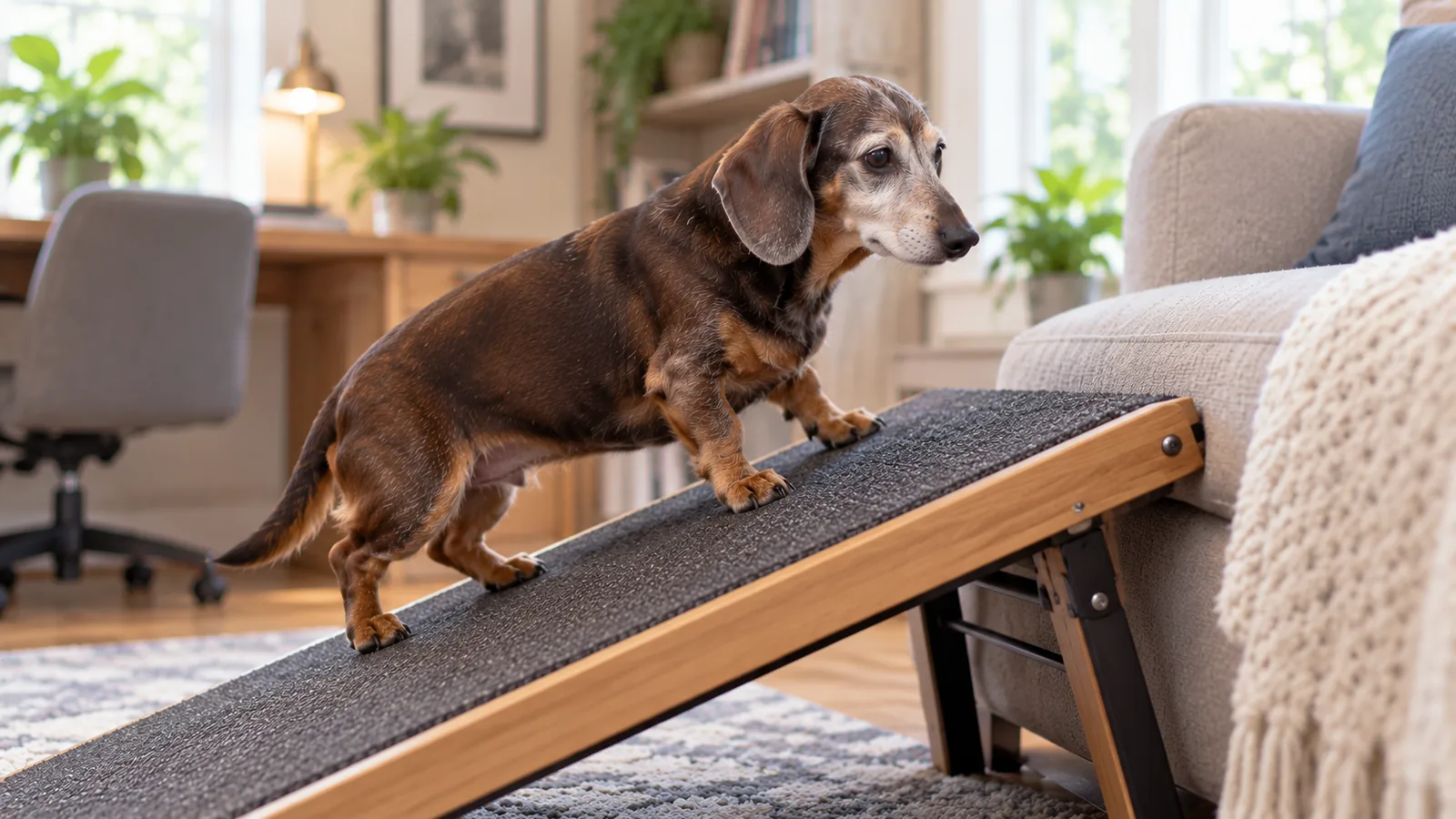
For a dog who loses footing outdoors as well as in the kitchen, traction booties cover the whole paw and hold on wet decks, icy walkways, and polished floors alike. Most arthritis-friendly home changes for dogs come down to runners over slick floors, a ramp at the back step, and raised bowls that take the reach out of every meal, added a few at a time so a senior dog isn't asked to relearn the whole house in one weekend.
Why Doesn't My Senior Cat Look Sore?
Cats hide discomfort far better than dogs. Feline mobility trouble reads as a change in habit rather than a limp. A cat who stops jumping to the windowsill, takes the stairs one at a time, or hesitates at the edge of the litter box is telling you something hurts. New sleeping spots at ground level instead of the back of the couch, and a dull or matted coat over the back and hips, usually mean that twisting around to groom those areas has become painful. Each of those deserves the same workup a limping dog would get.
The most useful home modifications for cats are a low-entry litter box, a step or ramp up to a favorite windowsill, and soft bedding at floor level, and they often buy a stiff cat months of comfort before any device enters the conversation. If your cat's routine has quietly changed this year, have them examined instead of waiting for a limp that may never come.
Which Harness Fits a Weak Back End?
The middle stage is harness territory, when the back end has weakened but real strength is still there to work with. A rear-end harness cradles the hips and puts a handle where you need one, which covers the three hardest moments of a senior day: getting up, going down stairs, and getting into the car.
Weakness in front, from a sore shoulder or a bad front leg, calls for a front-support style that lifts under the chest instead. When more than one limb is weak, a full-body support harness lifts front and rear together and stays on through the day. Help is there the moment it's needed rather than after a fall.
Two smaller tools matter for a dog whose back feet knuckle over or scuff the tops of the toes. Resistance bands run between the hind limbs to guide each foot into a better landing and keep the muscle working, and knuckling socks protect the toes while that foot placement improves.
Fit matters more than brand. A harness that rubs an armpit or slides back over the hips adds a new sore spot to a pet who already has one, so call us before you buy and we'll talk through which style matches where the weakness actually sits.
What Can a Cart Give Back to a Dog Who Can't Stand?
A cart isn't a last resort. Mobility carts for dogs take the weight off rear legs that can no longer push off, and a cart fitted properly and used for outings rather than all day gives a senior dog back the yard, the sniffing, and a place in the family's afternoon. Measurements have to be close, since a frame that sits wrong rubs and leaves pressure sores, and most dogs need a week or two of short, cheerful sessions with treats before the wheels feel normal. Plenty of seniors stay active in one for months or years.
Before you order, bring your dog in for measurements so our veterinarians can confirm the front end is strong enough to do the pulling and that the skin over the hips will tolerate a frame. Carts exist for cats too, though most cats do better with ramps, steps, and everything they need at floor level.
Which Conditions Drive Most Senior Mobility Loss?
Naming the condition behind a change in gait tells you how support will evolve over the next year. Three causes account for most of it, and each asks for a different plan.
Arthritis is the common one by a wide margin, and in cats it's close to universal by the teenage years even when nothing looks wrong from across the room. A harness handles the hard transitions, while pain control and a lean body weight do the real work on the joint itself.
Intervertebral disc disease can take a dog from normal to weak or down in a matter of hours, and the road back usually runs through rear-end support during recovery, with some dogs staying in a cart long term. A portion of these cases need spinal surgery, which is done at a specialty hospital. We make that referral and coordinate it for you.
Degenerative myelopathy moves the other direction, slowly and steadily, with support climbing from traction aids to a harness to a cart over months, so planning the next step early beats scrambling for it. This one isn't painful, and that's exactly what fools families into waiting. Telling it apart from a disc problem takes an MRI, which happens at a referral hospital rather than here.
Weak back legs aren't always one of those three, and we don't assume they are. Tick-borne illness is common enough in the Hudson Valley that Lyme disease belongs on the list when a dog turns stiff and sore over a few days, and hip dysplasia, bone cancer in a single limb, and the flat-footed, dropped-hock stance of a diabetic cat can all be mistaken for ordinary arthritis.
What Else Keeps a Mobility Aid Working?
A device handles the moment, and the plan handles the disease. Pain relief, a weight that doesn't overload sore joints, and targeted exercise decide how long any aid keeps working. The harness or the cart ends up being the last piece we pick, not the first.
- Pain control: Daily anti-inflammatories, monthly injections that block arthritis pain signals (one licensed for dogs, one for cats), and add-on medications such as gabapentin each have a place depending on the cause.
- Weight: Every extra pound travels through the same sore joints, and getting a heavy senior down to a lean weight often does more than any product named on this page.
- Joint supplements and omega fatty acids: Where they suit the case, they support cartilage and turn down inflammation, and they work best alongside pain medication rather than in place of it.
- Strength and balance: Veterinary physical rehabilitation builds what a device cannot, using targeted exercises that rebuild the rear-end muscle a senior pet loses fastest. We refer that work to a certified rehabilitation practitioner and help you get it scheduled.
- Comfort care here: Acupuncture and chiropractic care give a stiff senior another route to relief, which matters most for pets whose stomachs or kidneys limit what medications they can take.
A senior pet's needs change over months, not years. Schedule a recheck a few times a year so we can adjust the plan before the next stage arrives instead of after.
Frequently Asked Questions About Mobility Aids
Will a support harness make my dog's legs weaker?
Used the way it's meant to be, a harness does the opposite. It carries your dog through the moments that would otherwise end in a fall, then gets out of the way. Dogs who slip repeatedly stop trying, and that's where muscle is really lost. The rule is assist, don't carry: let your dog do the walking they can still do, and lift only for rising, stairs, and the car.
My dog only slips on the kitchen tile. Do we still need an exam?
Slipping on a smooth floor looks like a flooring problem, and sometimes that's all it is. But dogs compensate for a sore hip or a weak hock long before it looks like a limp, and a slick floor is where that hidden weakness first becomes visible. A quick exam separates a traction problem from an early joint or nerve problem, and the answer changes what you buy. Rugs won't do much for a back end that's losing nerve signal.
Is my pet too old to start rehabilitation?
Age on its own doesn't rule it out. What matters is whether pain is controlled and whether the heart and lungs can handle mild effort, and both are things we check first. Senior pets often gain the most from it, because the rear-end muscle they've lost is the same muscle that makes standing up possible. Sessions are short and low-impact, and much of the work carries over to simple exercises you do at home.
Keep Your Senior Dog or Cat Moving Comfortably
A slower senior pet doesn't have to be a sidelined one. The right aid for the stage, paired with pain relief, a sensible weight, and a little targeted exercise, keeps most dogs and cats comfortable and in the middle of family life far longer than families expect, and all of it starts with naming what changed. If your pet has been slipping, wobbling, or waiting for a hand to stand up, reach out and we'll figure out what's behind it together at LaGrange Veterinary Hospital in Lagrangeville.